How to Read Long Japanese Sentences With Commas
Japanese punctuation (Japanese: 約物, Hepburn: yakumono ) includes various written marks (also characters and numbers), which differ from those plant in European languages, as well as some not used in formal Japanese writing but oft found in more casual writing, such as assertion and question marks.
Japanese can be written horizontally or vertically, and some punctuation marks adapt to this change in direction. Parentheses, curved brackets, square quotation marks, ellipses, dashes, and swung dashes are rotated clockwise xc° when used in vertical text (run into diagram).
Japanese punctuation marks are usually total width (that is, occupying an surface area that is the aforementioned as the surrounding characters).
Punctuation was not widely used in Japanese writing until translations from European languages became common in the 19th century.[ane]
Japanese punctuation marks [edit]
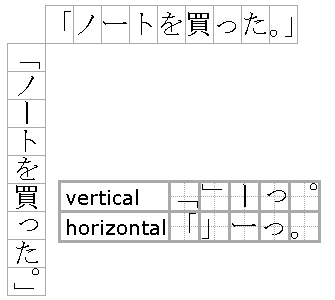
Diagram showing differences in placement of punctuation marks in vertical and horizontal writing, in a judgement containing hiragana, katakana and kanji.
Brackets [edit]
Various types of brackets ( 括弧 , kakko ) are used in Japanese. Every bit in English, brackets are used in pairs to ready apart or interject text within other text. When writing vertically, brackets are rotated clockwise ninety degrees. Each bracket occupies its own square when using genkō yōshi.
Braces [edit]
- { }
Namikakko ( 波括弧 , wave brackets)
Parentheses [edit]
- ( )
Marukakko ( 丸括弧 , round brackets)
Square brackets [edit]
- [ ]
Kakukakko ( 角括弧 , cornered brackets)
Lenticular brackets [edit]
- 【 】
Sumitsukikakko ( 隅付き括弧 , filled brackets), also known every bit lenticular brackets. Lenticular brackets are also used as quotation marks in the Japanese language.
Comma [edit]
| Symbol | Unicode | JIS X 0213 | Encoding |
|---|---|---|---|
| 、 | U+3001 | i-1-ii | 、 |
The comma ( 読点 , tōten ) is used in many contexts, principally for mark off separate elements within a sentence. In horizontal writing, the comma is placed at the bottom right of the preceding character. In vertical writing, it is placed immediately below and to the right of the last character, in a dissever square if using genkō yōshi. In horizontally written manuscripts that comprise a mixture of Japanese and Western characters, the full-width comma may be incorporated besides. No extra space is left after a comma.
| Symbol | Unicode | JIS X 0213 | Encoding |
|---|---|---|---|
| , | U+FF0C | i-one-4 | , |
Ellipsis [edit]
| Symbol | Unicode | JIS X 0213 | Encoding |
|---|---|---|---|
| … | U+2026 | 1-3-63 | … |
| ‥ | U+2025 | i-3-63 | ‥ |
Ellipses ( リーダー rīdā (leaders), 点線 tensen (dotted line), or てんてん ten-ten ("dot dot") bespeak an intentional omission or abbreviation, or a pause in voice communication, an unfinished thought or, at the end of a sentence, a abaft off into silence (aposiopesis). Ellipsis was adopted into Japanese from European languages.
The ellipsis is frequently three dots or six dots (in ii groups of three dots), though variations in number of dots exist. The dots can be either on the baseline or centred betwixt the baseline and the ascender when horizontal; the dots are centred horizontally when vertical.
Other uses:
- Every bit a substitute for dashes
- In manga and visual novels, the ellipsis by itself frequently represents speechlessness or a "pregnant pause"
Full stop [edit]
| Symbol | Unicode | JIS X 0213 | Encoding |
|---|---|---|---|
| 。 | U+3002 | one-i-3 | 。 |
The full stop ( 句点 , kuten ) is a small-scale circle. In horizontal writing, the total finish is placed in the same position every bit it would be in English, that is, at the bottom right of the preceding grapheme. In vertical writing, it is placed immediately below and to the correct of the terminal graphic symbol, in a separate square if using genkō yōshi. (Note the departure in placement with the traditional Chinese full terminate, which is placed in the centre of the foursquare.)
Dissimilar the Western full stop, information technology is often used to separate consecutive sentences, rather than to cease every judgement; it is frequently left out where a sentence stands lonely. No actress infinite is used after a full stop.
In manuscripts that comprise a mixture of Japanese and Western characters, the Western total stop may be incorporated as well.
Words containing total stops [edit]
Starting in the 1980s, advertising copy writers began incorporating full stops in titles and other advertising. In the 1990s, the grouping Morning Musume ( モーニング娘。 ) began using a total stop in its name, starting a fad for this usage. Other examples include the following:
- Good Person. ( いいひと。 , Ii Hito ), a manga by Shin Takahashi.
- Ecomoni. ( エコモ二。 ), a Japanese pop group from Hello! Project.
- Nobuta. wo Produce ( 野ブタ。をプロデュース ), a drama serial (dorama), produced and aired in 2005 by NTV.
- Your Name. ( 君の名は。 ), a 2016 Japanese blithe romantic drama motion-picture show written and directed past Makoto Shinkai.
Interpunct [edit]
The interpunct ・ ( 中黒 , nakaguro , "middle black") or "katakana centre dot" (every bit the Unicode consortium calls information technology) is a minor dot used for interword separation. It is also known as nakapochi, nakapotsu and nakaten. It has a fixed width that is the same as virtually kana characters.
Uses include:
- Separating Japanese words where the intended meaning would be unclear if the characters were written side-by-side
- To carve up listed items, instead of a comma: 小・中学校 (elementary and heart school) versus 小、中学校
- To separate foreign words and names when written in kana: パーソナル・コンピューター (personal computer), and occasionally for Japanese names, particularly when at that place would otherwise be defoliation as to where one name ends and another begins (in artistic writing, especially manga and low-cal novels when transcribing proper nouns, at that place'due south a fad of replacing the interpunct with an equal sign, a white star or any other "plumbing fixtures" symbol)
- Equally a substitute for a double hyphen
- To separate titles, names and positions: 部長補佐・鈴木 (Assistant Department Head Suzuki)
- As a decimal indicate when writing numbers in kanji: 三・一四 (3.xiv)
- In place of hyphens, dashes and colons when writing vertically
Part alternation mark [edit]

The part alternation mark
| Symbol | Unicode | JIS X 0213 | Encoding |
|---|---|---|---|
| 〽 | U+303D | 1-three-28 | 〽 |
The part alternation marking 〽 ( 庵点 ioriten or 歌記号 utakigō) is used to indicate the beginning of a song, or the start of the adjacent role player'southward function.
Information technology was about common in Noh chanting books and Renga (linked verse). In Noh books it is used to marker the outset of each character's (or the chorus') parts. The opening square quotation mark ( 「 ) may also be used.
Quotation marks [edit]
Single quotation marks [edit]
- 「 」
kagikakko ( 鉤括弧 , hook brackets)
Double quotation marks [edit]
- 『 』
- 〝 〟
Double quotation marks ( 二重鉤括弧 , nijūkagikakko ) are used to marker quotes within quotes: 「...『...』...」 every bit well as to mark book titles (Japanese does not accept italic type, and does not use sloping type for this purpose in Japanese). They are as well used sometimes, in fiction, to denote text that is heard through a telephone or other device.
Infinite [edit]
| Symbol | Unicode | JIS X 0213 | Encoding |
|---|---|---|---|
| ⟨ ⟩ | U+3000 | ane-ane-1 |   |

Utilize of spaces on genkō yōshi
1. 3 spaces before the title.
two. i infinite between the writer's family name and given proper noun; 1 space below.
3. Each new paragraph begins after a space.
4. Subheadings have one empty line before and after, and have ii spaces above.
five. Punctuation marks normally occupy their own square, except when they occur at the bottom of a line, in which instance they share a square with the last character of the line.
A infinite ( ) is any empty (not-written) zone between written sections. In Japanese, the space is referred to by the transliterated English name ( スペース , supēsu ). A Japanese space is the same width as a CJK grapheme and is thus also called an "ideographic space".
In English language, spaces are used for interword separation every bit well as separation between punctuation and words. In normal Japanese writing, no spaces are left betwixt words, except if the writing is exclusively in hiragana or katakana (or with piffling or no kanji), in which case spaces may be required to avoid confusion.
In Japanese, a unmarried space is often left before the first graphic symbol in a new paragraph, especially when writing on genkō yōshi (manuscript newspaper), and a infinite is left afterward non-Japanese punctuation marks (such every bit exclamation points and question marks). A space may be left between the family and given names equally well. When the grapheme is not hands available, a directly HTML equivalent is the   entity (em-space) which outputs the same fullwidth " " glyph.
A fullwidth space may exist used where a colon or comma would be used in English language: 大和銀行 大阪支店 (Yamato Bank, Osaka Branch).
Moving ridge dash [edit]

| Symbol | Unicode | JIS 10 0213 | Encoding |
|---|---|---|---|
| 〜 | U+301C | 1-1-33 | 〜 |
The wave dash 〜 ( 波ダッシュ , nami dasshu , wave dash) resembles a lengthened tilde (FULLWIDTH TILDE), which does not exist in JIS X 0208.
Uses in Japanese include:
- To indicate ranges ( 5時〜6時 , from five o'clock to six o'clock; 東京〜大阪 Tokyo to Osaka). In such cases it may be read as ...kara...made ( ...から...まで )
- To separate a championship from a subtitle on the same line; in English language a colon is used for this purpose.
- To mark subtitles: 〜概要〜
- In pairs, in identify of dashes or brackets: 〜〜答え〜〜
- To signal origin: フランス〜 (from France)
- To bespeak a long or fatigued-out vowel ( ですよね〜 or あ〜〜〜 ), commonly for comic or cute effect
- To signal or suggest that music is playing: ♬ 〜
- To suggest a ruled line: 〜〜〜〜〜 or 〜・〜・〜
Other punctuation marks in common utilise [edit]
The Japanese versions of these punctuation marks are usually total-width characters. A total-width space is usually left later such marks when writing in Japanese.[2]
Colon [edit]
- :
The colon ( コロン , koron ) consists of two equally sized dots centered on the same vertical line. As a rule, a colon informs the reader that what follows proves, clarifies, explains, or simply enumerates elements of what is referred to earlier. Although not a native Japanese punctuation marking, the colon is sometimes used, specially in bookish writing.
As in English, the colon is commonly used in Japanese to betoken time ( 4:05 , instead of 4時5分 or 4分5秒 ) or for lists ( 日時:3月3日 4時5分 24-hour interval/fourth dimension: March 3, 4:05pm).
Exclamation mark [edit]
- !
The assertion point or mark ( 感嘆符 , kantanfu ), besides colloquially called the びっくりマーク (bikkuri māku, lit. "surprise mark") is commonly used later an interjection or exclamation to bespeak strong feelings or loftier book, and more often than not marks the end of a judgement. A sentence ending in an exclamation mark is either an actual assertion ("Wow!", "Boo!"), a command ("End!"), or is intended to exist astonishing in some way ("They were the footprints of a gigantic hound!").
While there is no exclamation point in formal Japanese, it is very commonly used, peculiarly in casual writing, fiction and manga.
Question marker [edit]
- ?
In formal Japanese, no particular symbol is used to marking interrogative sentences, which cease with the normal Japanese full stop ( 。 ). However, the question mark is very normally used, especially in coincidental and creative writing and in manga. It is generally known formally as 疑問符 (gimonfu) or less formally はてなマーク (hatena māku), but the katakana form of "question mark" ( クエスチョンマーク or クエッションマーク ) is besides common.
Musical note [edit]
- ♪
This sign is added to the tail of a phrase, indicating it is a part of lyrics or someone is singing the phrase.
- example: うさぎおひし♪ かのやま♪
See too [edit]
- Iteration mark
- Japanese typographic symbols
- Due east Asian punctuation (disambiguation), notably:
- Chinese punctuation, which uses a similar set of symbols simply with some differences.
References [edit]
- ^ Croes, Jaered Koichi; Dexter, Kristen (21 March 2016). "「『The Art Of、 Japanese Punctuation〜。』」!?". Tofugu.
- ^ "感嘆符・疑問符の後の全角空白は本当にJIS由来? 中の人に聞いてみたよ " [Does the total space after exclamation points and question marks come up from JIS? I asked a person who knows.]. densho-chaneru. 14 November 2014.
Source: https://en.wikipedia.org/wiki/Japanese_punctuation
0 Response to "How to Read Long Japanese Sentences With Commas"
Post a Comment